Why Value Chain Decarbonization is the Next Strategic Frontier
For many organizations embarking on their sustainability journey, measuring direct emissions from facilities and purchased electricity is often the first step. However, companies soon discover that a significant portion of their climate impact lies beyond their immediate operations.
These indirect emissions, commonly referred to as Scope 3 emissions, can account for more than 70% to 90% of an organization's total carbon footprint, particularly in sectors such as manufacturing, consumer goods, automotive, chemical processing, and retail.
As investors, regulators, and multinational customers increasingly demand transparency across entire supply chains, Scope 3 emissions management has evolved from a voluntary initiative into a strategic business imperative necessary for protecting preferred supplier status and capital access.
The 15 Categories of Scope 3 Emissions
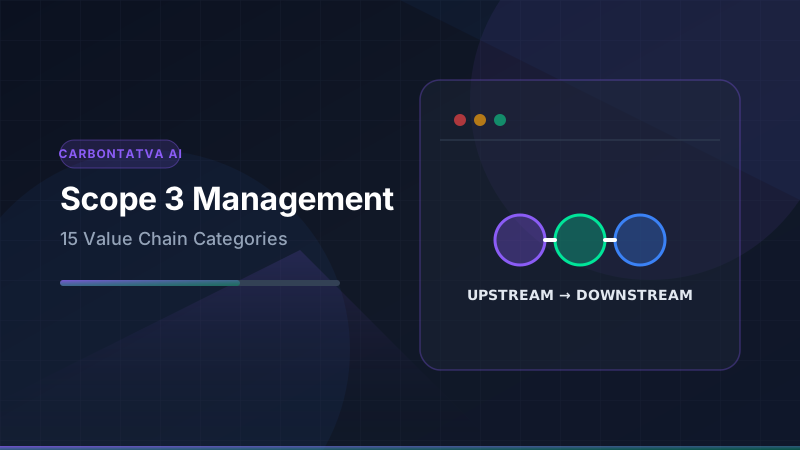
The Greenhouse Gas Protocol Corporate Value Chain (Scope 3) Standard defines 15 distinct categories divided into upstream and downstream operations:
Upstream Scope 3 Categories
- Category 1: Purchased Goods and Services (Typically the largest single emission category for manufacturing)
- Category 2: Capital Goods (Plant machinery, buildings, equipment infrastructure)
- Category 3: Fuel and Energy-Related Activities (Upstream emissions of purchased fuels and grid T&D losses)
- Category 4: Upstream Transportation and Distribution (Third-party inbound freight and logistics)
- Category 5: Waste Generated in Operations (Disposal and treatment of industrial scrap and wastewater)
- Category 6 & 7: Business Travel and Employee Commuting
- Category 8: Upstream Leased Assets
Downstream Scope 3 Categories
- Category 9: Downstream Transportation and Distribution (Outbound freight to customers)
- Category 10: Processing of Sold Products (Intermediate components manufactured into final goods)
- Category 11: Use of Sold Products (Direct energy consumption of products during customer use)
- Category 12: End-of-Life Treatment of Sold Products (Recycling, landfilling, or incineration)
- Category 13, 14 & 15: Downstream Leased Assets, Franchises, and Investments
The Three Major Drivers of Scope 3 Accountability
Three converging market pressures are forcing Indian enterprises to prioritize value chain carbon accounting:
- Net-Zero Credibility: Science Based Targets initiative (SBTi) rules mandate that if Scope 3 emissions represent over 40% of an enterprise's total inventory, formal near-term Scope 3 reduction targets must be established.
- Supply Chain Export Mandates: Under EU CBAM precursor rules, Indian exporters of steel, aluminium, and chemicals must trace and report embedded emissions from their upstream raw material suppliers.
- SEBI BRSR Core Assurance: Listed Indian companies must disclose and secure mandatory third-party reasonable assurance over value chain KPIs, creating a cascading data demand across unlisted tier-1 and tier-2 suppliers.
Overcoming Supplier Data Fragmentation and Spend-Based Traps
The single greatest operational barrier in Scope 3 management is collecting primary activity data from hundreds of suppliers who lack standardized carbon accounting capabilities. To begin reporting, many companies rely on spend-based economic input-output models (multiplying expenditure by industry average emission factors).
While spend-based modeling provides a quick initial screening, it penalizes cost inflation and cannot reflect supplier energy efficiency improvements. SEBI BRSR rules legally lock companies out of reverting to spend-based estimates once primary measurement is established.
Automating Value Chain Intelligence with CarbonTatva AI
CarbonTatva AI transforms Scope 3 management from an unmanageable vendor outreach project into an automated, continuous data pipeline. Our tatva.ingest platform features AI-powered OCR and supplier portal integrations that ingest raw freight bills, vendor energy declarations, and material test certificates.
By replacing generic spend estimates with verified primary activity data in tatva.measure, CarbonTatva AI enables enterprises to pinpoint high-emitting supply chain nodes and collaborate with key vendors on targeted decarbonization roadmaps.