The Expanding Perimeter of Industrial Carbon Compliance
India's broad manufacturing sector—spanning automotive components, consumer goods, industrial equipment, food processing, and diversified engineering—faces a carbon compliance landscape that is rapidly expanding beyond the heavy industries directly named in CCTS notifications. While large-format steel or cement plants face direct cap-and-trade mandates, mid-sized and downstream manufacturers are being pulled into the compliance ecosystem through three converging channels:
- BRSR Core Supply Chain Cascades: Top-listed Indian corporations must secure third-party reasonable assurance over their value chain emissions, forcing unlisted tier-1 and tier-2 manufacturing vendors to report verifiable carbon data.
- Indirect CBAM Precursor Demands: Manufacturers supplying steel components, aluminium forgings, or chemical sub-assemblies to European export chains must provide verified product-level embedded carbon figures to support their buyer's EU customs declarations.
- Investor & Banking ESG Mandates: Institutional lenders and private equity funds now evaluate supply chain carbon intensity as a material credit risk, tying working capital interest rates to verified sustainability performance.
Why Scope 3 Dominates General Manufacturing Risk
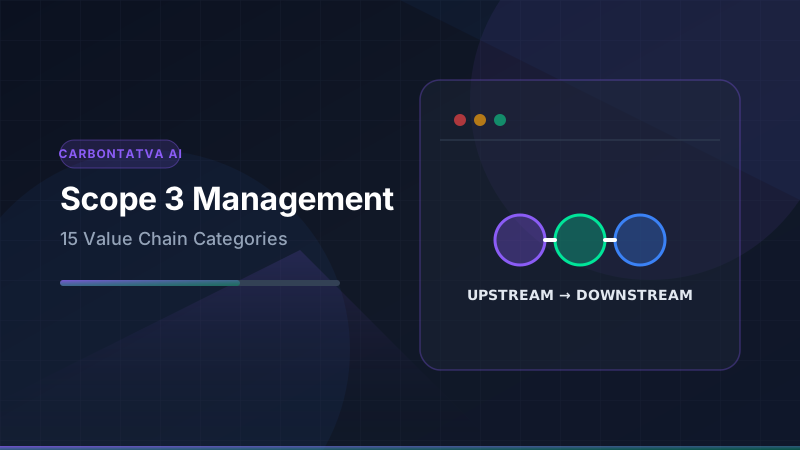
Unlike heavy metallurgy where direct kiln or blast furnace emissions dominate, general manufacturing exhibits a inverted emissions profile. Direct Scope 1 (boiler/generator fuel) and Scope 2 (grid electricity) typically represent only 15% to 30% of total footprint. The vast majority—70% to 85%—resides in Scope 3 value chain activities: purchased raw materials, component subcontracting, inbound/outbound freight logistics, and product disposal.
Managing this Scope 3 dominance requires shifting from internal site audits to comprehensive value chain data orchestration across hundreds of external suppliers.
Key Operational Challenges for Multi-Site Enterprises
- Multi-Site Data Fragmentation: Diversified manufacturers operate across dozens of decentralized factories, warehouses, and regional offices—each utilizing different state utility providers, local fuel vendors, and ERP software. Consolidating these fragmented records into a single audit-ready corporate inventory is a massive administrative bottleneck.
- Product-Level Intensity Allocation: Responding to customer CBAM precursor requests requires calculating exact greenhouse gas intensity per unit of product output (e.g., kg CO2e per machined gear or stamped bracket), requiring precise allocation of overhead facility energy across complex product bills of materials (BOMs).
- Supplier Onboarding & Data Verification: Gathering primary activity data from small, unlisted tier-2 suppliers who lack environmental training requires automated document collection and validation tools to avoid spend-based estimation lock-in.
High-Impact Decarbonization Levers for Manufacturing
To lower product-level carbon intensity and satisfy customer ESG requirements, manufacturers should prioritize three operational improvements: executing Green Open Access or rooftop solar PPAs to eliminate coal-grid Scope 2 emissions, upgrading compressed air and motor drive energy efficiency on assembly lines, and engaging tier-1 suppliers in collaborative material recycling and scrap reduction programs.
Automating Multi-Site Value Chains with CarbonTatva AI
CarbonTatva AI is built to resolve the multi-site fragmentation of diversified manufacturing. Through tatva.ingest, our platform automatically harvests utility bills, ERP production volumes, and logistics freight reports across all corporate facilities—using AI OCR to digitize physical vendor receipts.
In tatva.measure, the platform harmonizes multi-site data into a structured 3-section BRSR Core disclosure while calculating precise product-level carbon intensities for customer CBAM declarations. Supported by tatva.forecast to simulate renewable energy PPA ROI, CarbonTatva AI enables Indian manufacturers to turn value chain transparency into a preferred supplier competitive advantage.